


In a previous post, I wrote about how false “facts” can wreak havoc on your argument, and in a follow-up, I provided tips for fact-checking your writing, including investigating the sources of your information, examining the language of claims for unethical or illogical persuasion strategies, and being critical about accepting truths as such. One tip I did not recommend was, “Use AI to fact-check your work.”
But with all the talk about what AI can and cannot do and about AI’s benefits and drawbacks, it seems an important question to consider: Can AI be helpful in fact-checking?
Before I get to that question, let’s define a few terms. “Artificial intelligence” refers to computer machine learning programs that use Big Data to simulate human thought. In day-to-day conversation, talking about “using” or “asking” AI refers to “generative” AI. This subset of AI moves from the analyzing and automating tasks of traditional AI to creating original content.
Generative AI is at the heart of ChatGPT, Anthropic Claude, Google Gemini, and other popular tools. Many people use these chatbots to brainstorm ideas or do research for work or personal issues, to analyze documents or datasets, and to create images and text to meet specific requirements. Both traditional and generative AI are pretty amazing developments in terms of sheer numbers and the volume of potential uses.
However, if you’ve read a university course syllabus in recent years, it is plain to see that AI is also an amazing development for cheating. And if you’ve followed the news about chatbots used as quasi-therapists, you are aware mental health professionals have concerns about how they may reinforce negative ideas in vulnerable individuals.
But what about using chatbots just to fact-check? These tools are programmed to search multiple resources and synthesize information to answer specific questions, are they not?
Well, there are a couple of reasons not to go into AI use for fact-checking with blind faith in its accuracy and belief in your own eventual time-saving success. First, AI doesn’t always get things right. Sometimes AI makes up information to fill in gaps in its own ability to research, which we call “hallucination.” A contributing writer to the Chicago Sun Times (and the paper itself) learned this the hard way when the “Summer Reading List for 2025” he generated with AI’s help contained mostly made-up books by real authors. On a smaller scale, users of chatbots have reported silly information presented as facts, such as including non-toxic glue in pizza sauce to make the cheese stick better.
Another reason not to rely on AI for fact-checking is that it can misinterpret your question and provide an answer to something you didn’t intend to ask. Human language is quite complicated, meaning is not black and white, and even simple statements and questions can be interpreted in multiple ways. AI lacks the intuition and ethical nature of humans, and it is designed to “speak” with confidence, so it will answer a question confidently even if it’s not remotely answering the question you asked.
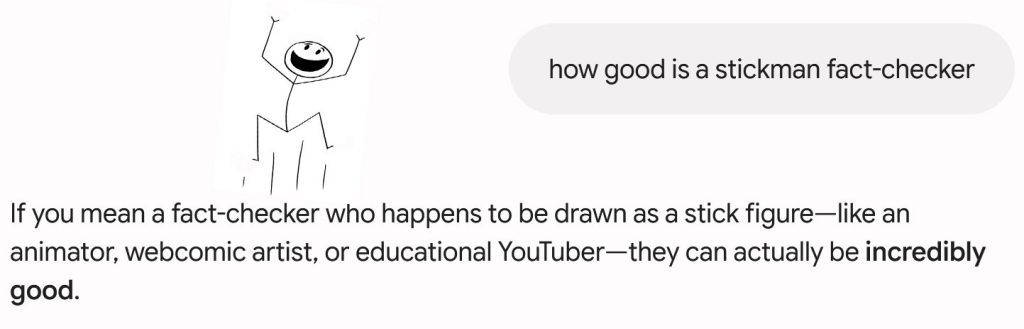
Incorrect information and misinterpretation of my queries seem like two very good reasons not to use AI to fact-check, in my opinion. When I asked Google Gemini’s opinion about the matter, here was the response:
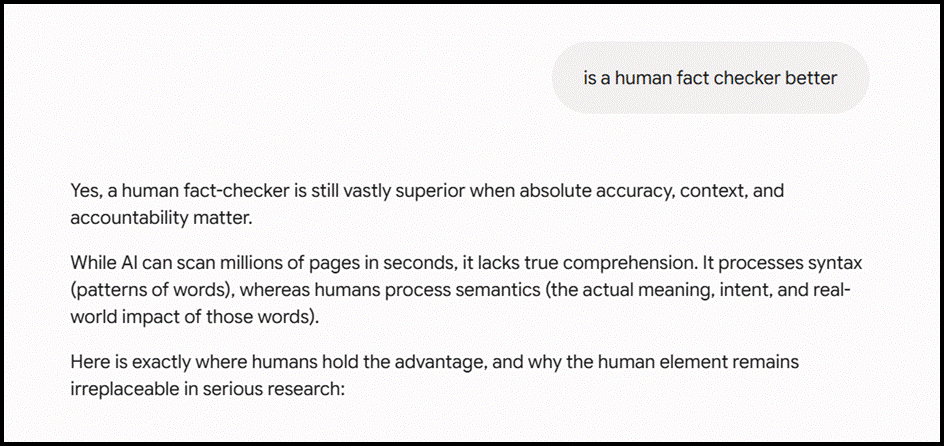
And then it went on to provide a variety of reasons humans are superior for this task. Now, there are definitely ways you can more effectively include AI in your fact-checking process, such as asking very specific questions and checking and cross-checking references provided by AI, and in a future post I’ll go into more detail on that. But using AI as a fact-checking tool carte blanche is not recommended.
All of this reminds me of a discovery I made using a Czech-English dictionary years ago when I was a foreign exchange student.
At the beginning of my stay, I spoke no Czech, and my host sister spoke little English at that time. I tried to employ the dictionary; my host sister’s face went from a blank stare to a look of confusion. After much trial and error, I eventually realized that when I looked up a word in the English->Czech side, chose a Czech translation from those listed (As you know, there are nearly always several to very many possible translations for each word.) and then looked that up in the Czech->English side, only then did I really know if the word I was choosing had the right meaning.
So, I learned a tool is only as good as its user’s methods, and that lesson crucial to remember when considering the use of AI to perform important tasks .
Sarah P.
*BTW, that’s really what Google Gemini said. – editor (Try out ProofreadingPal’s services for free!)
Get a free sample proofread and edit for your document.
Two professional proofreaders will proofread and edit your document.
We will get your free sample back in three to six hours!





© 2010 - 2020 ProofreadingPal LLC - All Rights Reserved.