



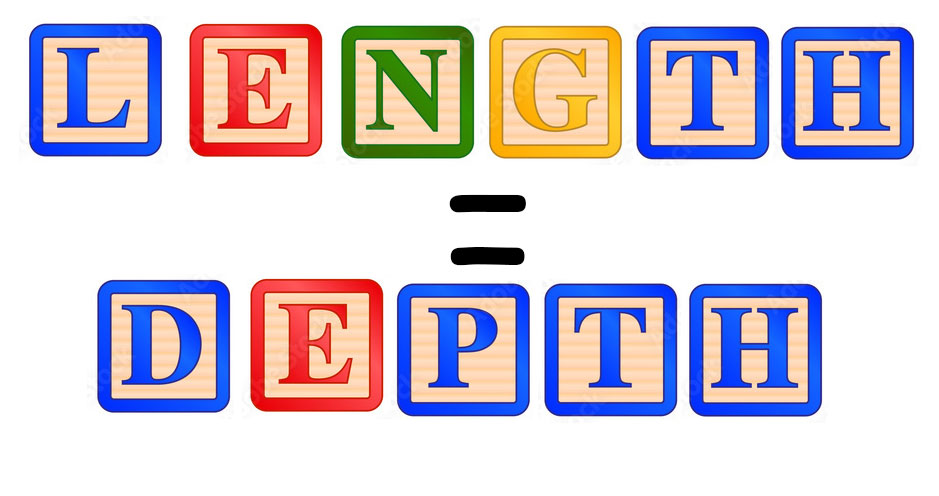
It’s one of the greatest miscommunications in education, business, and writing in general: paper length doesn’t just mean “paper length.”
Instead, the length of the paper, whether it’s measured by words or pages, indicates how deeply the boss/teacher/publication wants the writer to go into the subject matter.
Let’s start with one of the worst offenders: the resume writer. Unless specific instructions differ, a resume, particularly for an entry-level position, is one page. (This is different from a CV, which we’ll discuss next time.)
First, “one page” is not something to mess with. It’s not “one page” if the text is tiny (smaller than TNR 12 pt.) or the margins are narrow (less than 1” all around). You’re also not supposed to cheat with excessive abbreviations or links to online content that hasn’t been requested.
Resume one-page padding is also taboo. No repetition, big fonts, graphics, underlines, or the like are acceptable. If your information fills half the page, that’s what you go with.
All of this makes sense if you remember that it’s not just about keeping the resume to one page but also about offering one page’s worth of information. A resume is not a biography or an admissions essay. It’s an almost brutal paring down of what you can do for whoever’s hiring.
The one-page resume is supposed to cover:
And that’s it. One page. If you’ve had twenty jobs, don’t list those that don’t relate to the position you’re applying for. If you speak a “little” Spanish, no one cares except the waiter.
The page limit (with regular font and margins) indicates how far into the subject matter the instructor wants you to go.
Let’s say the assignment is a comparison/contrast paper of the US vs. UK judicial system. Paper Assignment A is three pages, and Paper Assignment B is thirty pages.
A: Having three pages to work with means three or four well-made points supported with evidence , examples, and explanation. You’ll have room for a little nuance, but not much. You want to hit the major issues and do not need to make some sort of complex argument about abilities and scope.
So, for contrast, you could discuss the US “court attire” standards of a suit vs. the UK wearing of robes and wigs and the US use of specific courts for various types of litigation vs. the UK tribunal system. For comparison (similarities), you might discuss that in both systems, the burden of proof is on the prosecution in criminal cases, and witnesses are sworn in before giving testimony.
And there: you’ve made firm, demonstrable points and backed them up. You have a little room for an observation or two, perhaps pointing out that the two systems are much more alike than different.
B. Having thirty pages to work with means you’re supposed to come up with a much more nuanced argument that digs well below the surface. You’re expected to go into the details of the differences and similarities and make personal commentary on them (supported by evidence) that shows you know what you’re talking about. You even have room for a case study or two.
Moreover, at thirty pages, you’re expected not to waste the reader’s time with obvious, self-evident points. You’re to have an overall argument that holds the length together, such as that the presence of Christianity is evident in both but in different ways that hold to some sort of pattern or conclusion about the systems in general.
What I said about essays is also true about articles and reports. The major difference is that instructors are typically tolerant of essays that go a little long. For articles headed to the boss or publication, being over can be even worse than being under, both in length and in depth. When the manager asks for a quick email, skip the forty-point breakdown of a labor process.
So, the next time you’re told to write 2,000 words, think about the length in terms of content. How far into the subject matter do 2,000 words let you dive?
Julia H.
Get a free sample proofread and edit for your document.
Two professional proofreaders will proofread and edit your document.
We will get your free sample back in three to six hours!





© 2010 - 2020 ProofreadingPal LLC - All Rights Reserved.